On the Exploitation and Significance of Bivalve Shells at the Magdalenian Site of Petersfels (Southwestern Germany) Using an Integrated Approach
Abstract
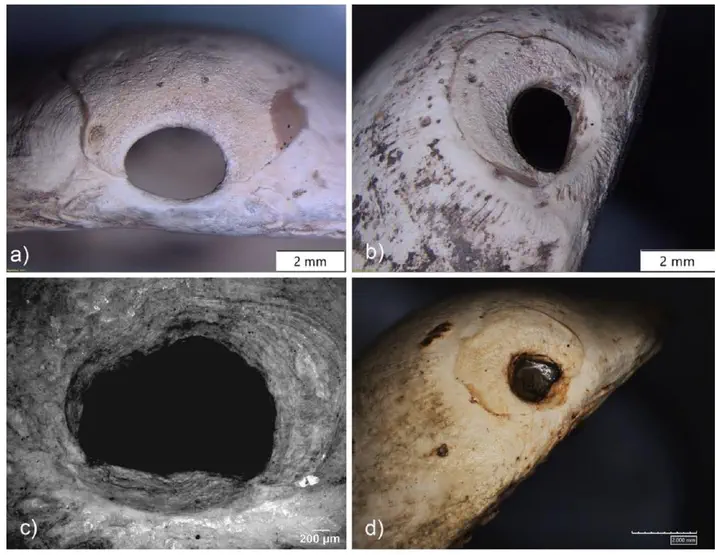
Marine shells and freshwater mollusks serve as valuable proxies for understanding cultural and environmental interactions in human history. They provide insights into past activities, exchange networks, and ecological dynamics. The site of Petersfels in Germany, rich in modified shells, offers a unique opportunity to investigate the significance of mollusk shells for the Magdalenian of central Europe. This study presents findings from our investigation of the nearly complete collection of bivalve shells recovered from the site, including 84 Glycymeris sp. specimens, 2 Gryphaea arcuata, 2 Polymesoda sp., and a fragment of an Ostrea sp. By applying qualitative and quantitative methods accompanied by a comprehensive experimental program, we sought to (1) uncover the origins and selection of the bivalves, (2) discuss modifications of shells made by anthropogenic and natural agents, and (3) elucidate aspects of their functions and symbolism. Our findings reveal that the bivalve shells were modified into ornaments. Despite taphonomic alterations affecting surface traces, we observed signs of modification such as flat facets featuring parallel striations produced by abrasion, signs of prolonged use and reuse, and a perforation technique consistent with sawing. Double-perforated shells indicate a willingness to reuse them after the first perforation wears down. The two fossil specimens of Gryphaea arcuata and the fragment of an oyster were instead perforated by drilling. The entire sample showed rounded and smooth perforations and evidence of plastic deformations, hinge thinning, and worn facets resulting from extended use. The evidence of reusing shells and their extended lifespan highlights their significance in the symbolic and artistic expressions of the Magdalenian groups, reflecting the complex social and symbolic communication among these prehistoric communities.
Armando Falcucci
Lecturer in Palaeolithic Archaeology
I am a Lecturer in Palaeolithic Archaeology at the University of Southampton (CAHO). My research investigates the interplay between technological evolution, mobility, and human-climate interactions across Europe, the Levant, and southern Africa. Using a combination of traditional and computational methods, I explore cultural transmission and demic spread during the MIS3.