Application of 2D shape analysis to study Epigravettian lithic assemblages: assessing its analytical potential
Abstract
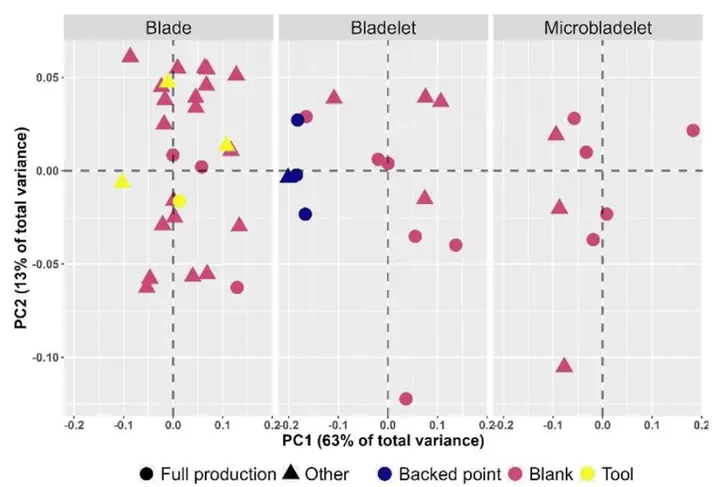
In this paper, we apply a two-dimensional (2D) Geometric morphometric analysis to a sample of Epigravettian lithic artefacts with the aim of assessing the potential of such an approach to study Epigravettian lithic assemblages. The lithic sample comes from layer 9c2 (Evolved Epigravettian, Upper Palaeolithic, about 18,000-19,000 years ago) of Grotta Paglicci (Apulia, southern Italy). After extracting the outline coordinates from high-resolution images using the software DiaOutline, we conduct Elliptic Fourier Analysis, Principal Component Analysis, and Linear Discriminant Analysis in the R package Momocs to investigate the internal variability of the sample. Shape analysis confirms that 1) the production of microbladelets was not linked to a dedicated reduction sequence and 2) the modification of blanks into backed points followed a rather standardised stone tool design. The result opens interesting perspectives for the routine implementation of 2D shape analyses complementary to the classical technological ones.

Armando Falcucci
Lecturer in Palaeolithic Archaeology
I am a Lecturer in Palaeolithic Archaeology at the University of Southampton (CAHO). My research investigates the interplay between technological evolution, mobility, and human-climate interactions across Europe, the Levant, and southern Africa. Using a combination of traditional and computational methods, I explore cultural transmission and demic spread during the MIS3.