Reconstructing the sequentiality of adjacent flake removal scars on lithic 3D models: A curvature-based computational approach
Abstract
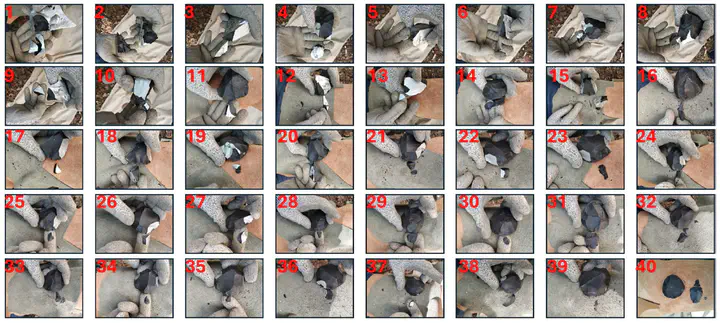
The traditional reconstruction of lithic reduction sequentiality relies on subjective human judgment, which is susceptible to material quality and observer experience. This study evaluates the efficacy of multiple digital geometric metrics for predicting scar sequentiality using three-dimensional scans on a technologically varied set of small-sized experimental lithic artifacts. We tested a variety of quantitative measures, including scar area size, compactness, node degree and betweenness, alongside the average and near-ridge curvature. Our results demonstrate that local curvature values measured near the common ridge provide the most reliable signature for chronological reconstruction, outperforming all other metrics. The method achieved a moderately high accuracy of up to 75%, demonstrating performance comparable to human analysts. A Generalized Linear Mixed Model (GLMM) was used to identify the factors impacting reconstruction success, showing that success is primarily determined by local scar geometry: the presence of a hinge or step was associated with higher odds of success, and opposed direction also showed a strong positive effect. In contrast, reduction method, raw material, cortex, and blank type showed limited influence on reconstruction outcomes, indicating the method’s robustness to broader technological and material variation. These results validate the curvature principle as a powerful, replicable tool for analyzing large samples of small-sized artifacts, paving the way for large-scale comparative analysis of lithic assemblages.
Armando Falcucci
Lecturer in Palaeolithic Archaeology
I am a Lecturer in Palaeolithic Archaeology at the University of Southampton (CAHO). My research investigates the interplay between technological evolution, mobility, and human-climate interactions across Europe, the Levant, and southern Africa. Using a combination of traditional and computational methods, I explore cultural transmission and demic spread during the MIS3.