Ex Oriente Lux? A quantitative comparison between northern Ahmarian and Protoaurignacian
Abstract
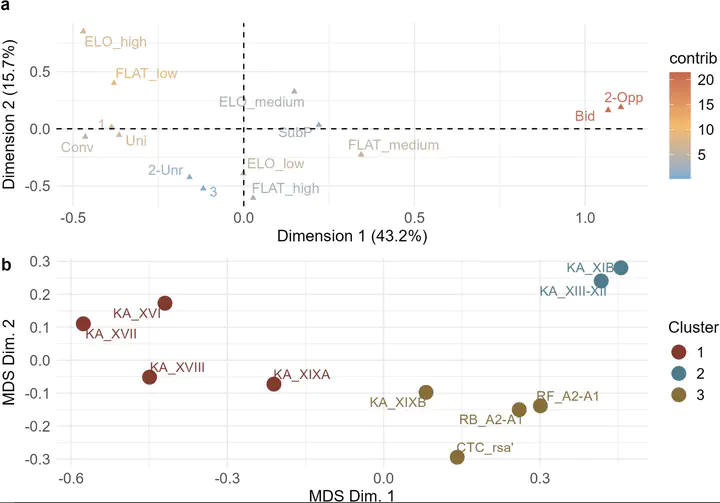
The appearance of the Protoaurignacian in Europe around 42,000 years ago is widely believed to result from a major dispersal of anatomically modern Homo sapiens out of the Levant, a view primarily supported by perceived similarities between Mediterranean Protoaurignacian and Levantine Ahmarian stone tools. However, no quantitative technological comparison has yet thoroughly tested this connection. Here, we present the first systematic evaluation of lithic technology from Protoaurignacian assemblages in Italy and from the northern Ahmarian and post-Ahmarian layers at the reference sequence of Ksar Akil (Lebanon). Using attribute analysis and multivariate statistics, we assessed technological similarities and differences across different stages of the core reduction sequence. Our results demonstrate very limited affinities and distinct technological trajectories between the two regions. While the northern Ahmarian at Ksar Akil is characterized by bidirectional volumetric core reduction aimed at blade production, the Protoaurignacian exhibits a strong emphasis on bladelet production from unidirectional cores. Although lithic miniaturization trends are observed in both regions, the post-Ahmarian layers at Ksar Akil primarily produced twisted bladelets from burins and carinated cores—a feature uncommon in the Protoaurignacian. These findings challenge the hypothesis of a Levantine origin for the Protoaurignacian and, more broadly, suggest that technological convergence—driven by the growing importance of multicomponent projectile technology and increased mobility—played a central role. Thus, our study underscores the need to reconsider diffusionist explanations and emphasizes the central role of internal cultural innovation among foraging groups settled in different regions of the Old World in shaping the emergence of the Upper Paleolithic.
The paper has been featured in several national and international news outlets, including:
- Discover Magazine (English)
- Geo.fr (French)
- Pikaia.eu (Italian)
- Phys.org (English)
- Science & Vie (French)
- Stuttgarter Zeitung (German)
The original press release is from the University of Tuebingen.

Armando Falcucci
Archaeologist
My research focuses on the earliest stages of the Upper Paleolithic across Europe and the Levant. I am currently investigating several Aurignacian and Ahmarian sites to understand the intricate relationships between archaeological patterns, cultural transmission, demic spread, and technological convergence.